
Proof of Concept - Bidirectional Pedestrian Flow
Experimental Aim
To determine if the McMatcher gives similar counts to manual counts (counts performed by the research team observing and counting people) on a University street where the flow of people predominatly goes in two directions, either 'in' or 'out' of the University. The chosen location often has a high number of pedestrians and pedestrian loading varies depending on the time of the day.
Method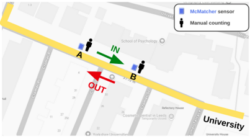
Two McMatcher devices were deployed on the street at locations A and B in the picture and were set up to continuously scan for Bluetooth signals from devices on nearby pedestrians. These two locations are seperated by a distance of 38 meters. Two people also stood at location A and B and both manually counted pedestrian flow both in and out of campus. The McMatchers and manual counters collected data for 45 minutes.
Results
Pedestrian counts from the two manual observers were similar to those from the McMatcher devices.
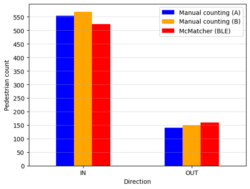
A graph showing the pedestrian counts from two manual observers and the McMatcher devices. The counts from two manual observers for the 'in' pedestrian flow was ~550 for observer A and ~570 for observer B. The McMatcher count was ~525. For the 'out' direction manual observer A counts ~140, B ~150 and the McMatcher ~160.
The data from the McMatcher devices can be used to determine a representative flow of pedestrians over time. In this case the 'in' flow of pedestrians can be see to increase up until 10am when many morning lectures start.
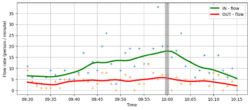
A graph showing the 'in' and 'out' flow of foot traffic throughout the course of the experiment . There is a clear peak of 'in' flow at around 10am when lectures start. No such peak is seen with the 'out' flow.
Conclusion
The McMatcher shows good correlation to manual counts (which will also be subject to a level of error - particularly at high pedestrian counts) and represents a viable alternative to manual counts. The McMatcher can also successfully determine the number of pedestrians travelling 'in' and 'out' of the University at different times of the day.